
County-Level Differences That Affect Divorce Real Estate Timelines in Minnesota: Hennepin, Ramsey, Dakota, Anoka, Washington, and Wright
When clients call about selling a home during divorce, one of the first questions I ask is which county the dissolution is filed in. It is not small talk. The county where your case sits — and where the marital home is located — directly shapes the timeline, the procedure, and often the strategy of the real estate side of your divorce.
Minnesota family law is governed by state statute, but how that law moves through the system varies meaningfully from one county to the next. Court calendars differ. Local rules and standing orders differ. The roster of approved neutrals differs. The real estate market itself differs. If you are working through a divorce that involves real property in Hennepin, Ramsey, Dakota, Anoka, Washington, or Wright County, here is what you should actually know.
Hennepin County
Hennepin operates the largest family court in the state and carries the highest volume of dissolution filings. That volume has consequences. Scheduling temporary hearings, evidentiary hearings, and trial dates generally takes longer here than in the surrounding counties. Contested matters can stretch out, and motions filed today may not be heard for weeks.
Hennepin also has one of the most developed Early Neutral Evaluation programs in the state, including both Social Early Neutral Evaluation (SENE) and Financial Early Neutral Evaluation (FENE). For real estate, the FENE process is where home valuation, equity, and proposed sale or buyout terms often get an early reality check. A well-prepared pricing analysis, listing strategy, or buyout proposal brought to FENE can move a case forward in one session. An unprepared one will cost you weeks.
The Hennepin County market is one of the broadest in Minnesota. Minneapolis condos, urban single-family homes, lake properties, and inner-ring suburban homes do not move the same way. For a divorce sale, pricing the marital home requires neighborhood-specific data — not a countywide average.
Ramsey County
Ramsey County family court is the second busiest in Minnesota. Scheduling is generally more responsive than in Hennepin County, although timelines can vary depending on the assigned judicial officer. The ENE process is well established in Ramsey County and is routinely used before contested temporary hearings.
Ramsey County has a significant inventory of older, character-rich homes in St. Paul, many built before 1940. In divorce real estate, those homes often come with inspection issues that cannot be ignored. When one spouse wants to sell and the other wants to buy out the marital interest, the property’s condition and the cost of deferred maintenance become real valuation and negotiation issues. I have seen FENE outcomes shift based on something as specific as a roof report or foundation evaluation.
Recording times at the Ramsey County Recorder's office tend to be predictable, which matters when a court-ordered sale needs to close on a tight timeline.
Dakota County
Dakota County family court generally moves more efficiently than Hennepin or Ramsey County on routine matters. Scheduling is often faster, and the bench is familiar with real estate sale orders, buyout terms, and structured property-resolution issues.
The Dakota County housing market, including Apple Valley, Eagan, Burnsville, Lakeville, Rosemount, Farmington, and Inver Grove Heights, is largely suburban, with single-family homes and townhomes making up much of the inventory. School district boundaries have a real impact on buyer demand, pricing, and market time. In a strong school district, a divorce-related listing can still sell quickly, even during a slower season. A similar home located just outside that boundary may take longer to sell and may require more careful pricing.
Dakota County also has an active ENE process. In many cases involving financial disputes, local judges expect parties to make a good-faith effort through ENE before asking the court for an evidentiary hearing.
Anoka County
Anoka County family court is generally efficient. Scheduling delays are often shorter than in Hennepin or Ramsey County, and the bench tends to keep cases moving.
The local housing market — including Blaine, Coon Rapids, Andover, Ham Lake, Lino Lakes, and Ramsey — often offers more accessible price points than many inner-ring Twin Cities suburbs. That can expand the buyer pool. However, not every pocket of Anoka County moves at the same pace. Some areas have lower transaction velocity, so pricing a marital home for a reliable sale within a court-imposed timeline requires current, property-specific local data — not a broad Twin Cities average.
When a divorce involves a VA loan release of liability, loan assumption, or refinance buyout, Anoka County also has a strong network of lenders familiar with those transactions. That experience matters, especially when one spouse is a service member or veteran.
Washington County
Washington County family court is generally one of the more efficient courts in the Twin Cities metro. Scheduling is often cooperative, and the court is familiar with well-prepared real estate motions, proposed sale orders, and the practical timelines involved in selling a marital home.
The Washington County market includes Woodbury, Stillwater, Cottage Grove, Lake Elmo, Oakdale, portions of Forest Lake, and portions of Hugo. These areas include highly desirable suburban inventory and several strong school districts, which can support buyer demand when a property is priced and presented correctly. Stillwater’s historic homes require careful pricing analysis. Woodbury new construction competes in a different segment of the market. In a divorce sale, these local differences matter.
A Washington County divorce sale can move efficiently when the home is properly prepared, accurately priced, and supported by a clear court order. Recording through Washington County is typically prompt, which can be especially important when the court has imposed a firm closing deadline.
Wright County
Wright County — including Buffalo, Monticello, St. Michael, Albertville, Otsego, parts of Rogers, Maple Lake, and Delano — is the most rural of the six counties, and its family court environment reflects that. Caseloads are generally lower, routine matters often move more efficiently, and the local legal culture tends to value practical, resolution-focused outcomes.
The real estate market also operates differently than the inner metro. Days on market can be longer in certain price ranges, and the buyer pool for higher-priced properties is typically more limited. Hobby farms, acreage properties, and rural residential homes require valuation methods that do not always align with Hennepin or Ramsey County comparables.
When a divorce involves real estate in Wright County, the appraisal, pricing analysis, and listing strategy should be based on Wright County market data. Relying on broad metro averages can create inaccurate expectations, weaken negotiations, and mislead both attorneys and the court.
The Patterns That Hold Across All Six Counties
A few realities apply regardless of which county the case is in.
Court scheduling controls the outer timeline. If the court cannot hear a contested sale motion for ten weeks, the sale cannot be ordered sooner. Understanding the local court calendar helps both parties plan strategically instead of reacting under pressure.
The ENE process is often where the real estate issue is resolved. A defensible valuation, credible pricing analysis, and realistic listing or buyout timeline can allow the real estate portion of the case to settle during FENE. Showing up without that information creates delay, increases costs, and weakens decision-making.
Local market conditions determine what the sale actually looks like. A 30-day close in Woodbury is not the same as a 30-day close in Buffalo. Pricing strategy, buyer behavior, inspection expectations, marketing approach, and lender performance vary by county and by submarket.
Recording and title timelines matter when the court sets a deadline. County recorder processing, quit claim deed preparation, title clearance, lien payoff coordination, and closing logistics all affect whether the parties can meet the court’s order. Missing a deadline can result in another motion, additional fees, and more delay.
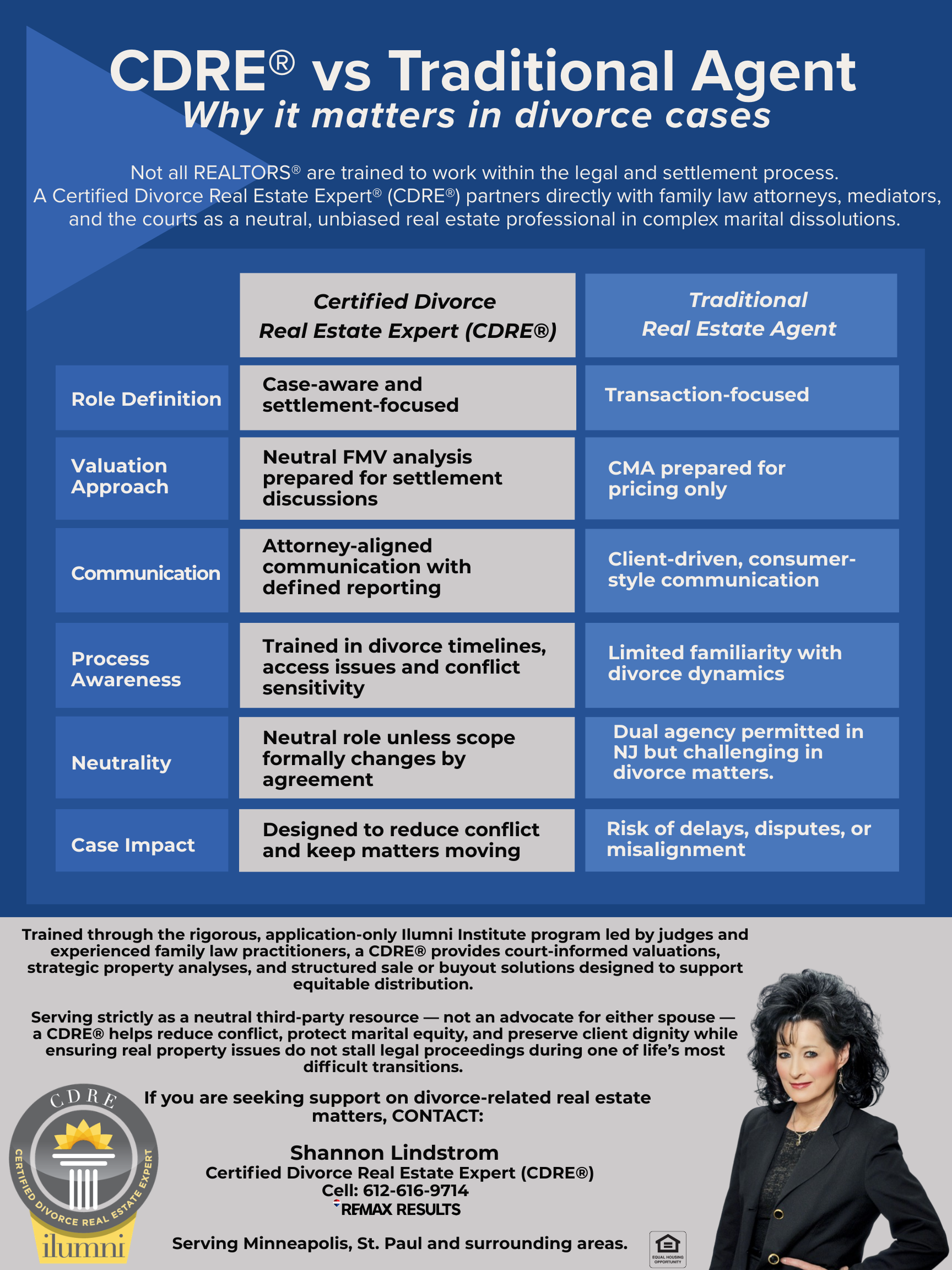
Why a Certified Divorce Real Estate Expert (CDRE®) Matters Here
A traditional real estate agent can list a house. A divorce real estate transaction requires far more.
When real estate is part of a divorce, the sale may involve court orders, two parties with competing interests, attorneys, financial professionals, court-appointed neutrals, firm deadlines, and documentation that must be clear, accurate, and defensible.
That is why the CDRE® designation exists.
As a Certified Divorce Real Estate Expert with RE/MAX Results, my role is to provide neutral, objective real estate guidance in divorce-related matters. Whether I am contacted by one spouse, both spouses, an attorney, or appointed through the court, the responsibility is the same: protect the integrity of the process.
That means providing defensible pricing, thorough documentation, balanced communication, careful coordination with legal and financial professionals, and a real estate process that can withstand scrutiny if the matter is reviewed in court.
Local experience also matters. Divorce real estate is not handled in a vacuum. County procedures, court expectations, timelines, and market conditions can directly affect how smoothly a case moves forward. Understanding the difference between a Hennepin County FENE process and a Wright County status conference is not a small detail. It can affect preparation, timing, strategy, and ultimately the protection of equity.
For individuals going through divorce, the first few weeks are important. Early decisions can shape the options available later. Accurate information, experienced professionals, and a measured process matter.
If your divorce involves real estate, do not approach it like a standard sale. Work with professionals who understand both the real estate transaction and the family law environment surrounding it.
That is where I can help.
Shannon Lindstrom, REALTOR® Certified Divorce Real Estate Expert (CDRE®) Military Residential Specialist (MILRES) | Military Relocation Professional (MRP) | Veterans Certified Agent (VCA)
RE/MAX Results | Serving Minneapolis–St. Paul and the Surrounding Twin Cities Counties
📞 612-616-9714
🌐 www.MNDivorceRealEstateExpert.com
🌐 www.ShannonLindstromRealtor.com
🌐 www.ShannonLindstrom.info
🌐www.ilumniinstitute.com/cdre/shannon-lindstrom
Shannon Lindstrom, REALTOR® Certified Divorce Real Estate Expert (CDRE®) Military Residential Specialist (MILRES) | Military Relocation Professional (MRP) | Veterans Certified Agent (VCA)
RE/MAX Results | Serving Minneapolis–St. Paul and the Surrounding Twin Cities Counties