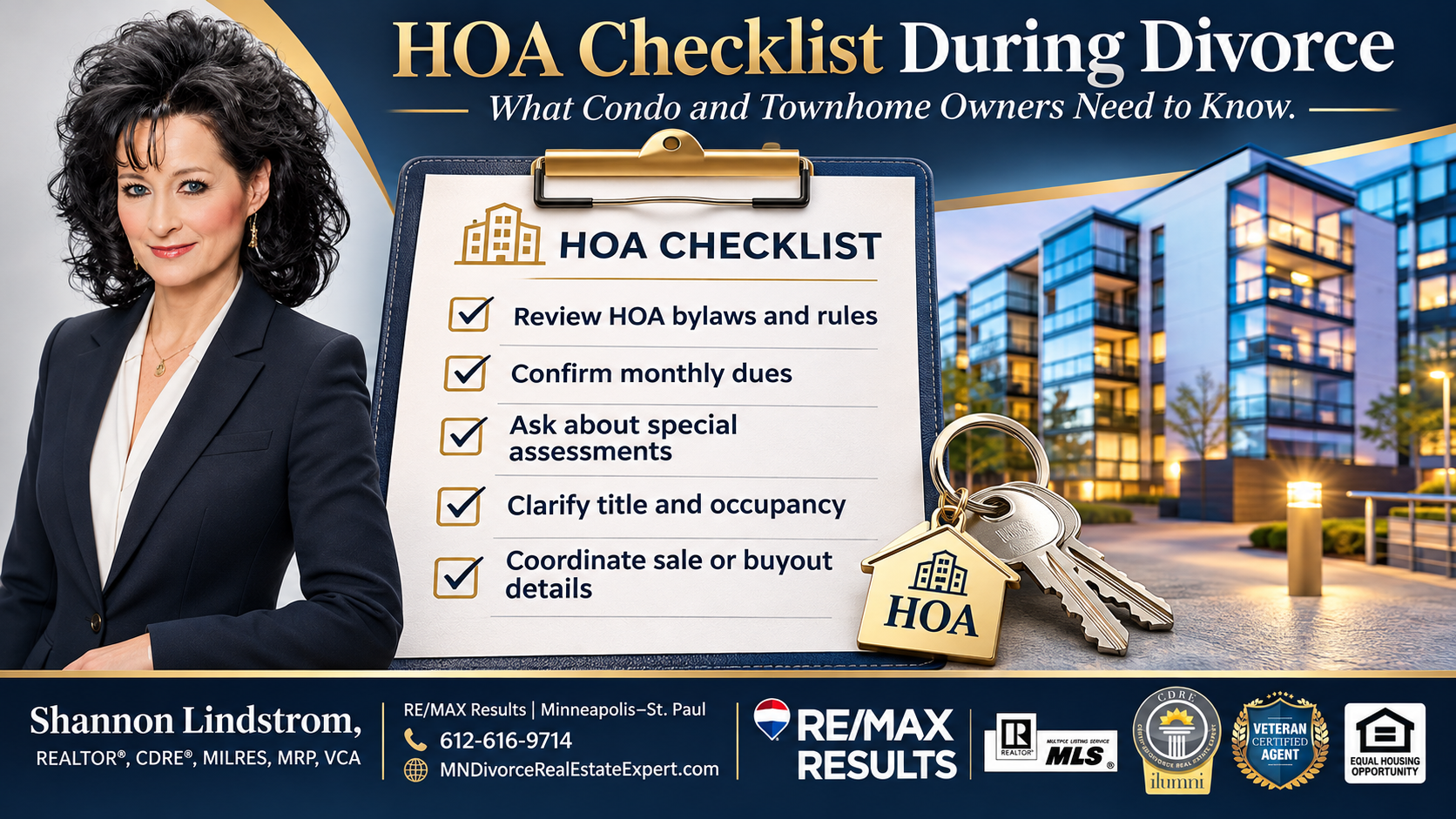
When the House Comes With a Third Party
When a couple divorces and the home is a condo or townhome, there's someone else at the table who never signed the divorce papers: the homeowners association.
The HOA doesn't care who keeps the unit, who moved out, or what the decree says. It cares that dues get paid, rules get followed, and the paperwork is in order when the unit changes hands. That can catch divorcing owners off guard, especially when one spouse handled all the HOA mail for years and the other has never seen a budget or a board notice.
I've worked with many Twin Cities couples in this exact spot. The good news is that almost every HOA surprise can be avoided with the right questions, asked early. Below are the six areas I look at in every divorce involving a condo, townhome, or other association-governed home: assessments, reserves, special assessments, insurance, rental restrictions, and transfer requirements.
1. Assessments: The Bill That Doesn't Pause for Divorce
Monthly HOA dues (known as “common expense assessments") keep coming whether the divorce takes three months or three years. And unlike a utility bill, unpaid assessments can become a lien against the unit itself. In Minnesota, an association can enforce that lien through foreclosure, and late fees, fines, and collection costs can stack up quickly.
What I see go wrong most often:
One spouse moves out and assumes the other is paying the dues.
The spouse who stays stops paying because they feel they shouldn't carry the whole cost.
Nobody updates the HOA's mailing address, so late notices go to someone who no longer lives there.
The HOA will look to the owners on title, not to whoever the temporary order says should pay. If both names are on the deed, both of you are exposed.
What to do: Put dues on the list of carrying costs in any temporary agreement or order. Ask the HOA or management company for a current account ledger showing a zero balance, or exactly what's owed. Make sure both spouses receive notices until title changes. If you're deciding whether one of you can keep the unit, count the dues as part of the monthly housing payment, because mortgage lenders will.
2. Reserves: The Hidden Number Behind the Value
Association may be responsible for replacing big-ticket items over time: roofs, siding, parking lots, elevators, boilers, windows. The reserve fund is the savings account that pays for them. A healthy reserve means those projects get paid for out of money already collected. A thin reserve usually means a special assessment or a dues increase is coming, and that affects what the unit is really worth.
This matters in divorce because two units with the same list price can carry very different future costs. If one spouse is keeping the home, a weak reserve is a real liability they're taking on. If you're selling, buyers and their lenders will look at it too.
Minnesota law now requires the seller to hand the buyer a copy of any reserve study the association obtained in the past three years, along with the resale disclosure certificate (Minn. Stat. § 515B.4-107). The certificate itself lists the components the association must replace and the amount currently held in reserves.
What to do: Get the reserve study and the current budget early, before you agree on a value or a buyout number. Ask when the study was done, which big components are due in the next five years, and whether the association is funding reserves at the level the study recommends. Share the answers with your attorney or mediator so the number everyone negotiates from reflects reality.
3. Special Assessments: Who Pays for the New Roof?
A special assessment is a one-time charge the association levies for a project the reserves can't cover. They can run from a few hundred dollars to tens of thousands per unit. In a divorce, the timing is everything, because a special assessment approved now can land on whoever owns the unit later.
There are three stages to watch for:
Levied and payable. The assessment is on the books, often in installments. The resale disclosure certificate will show it.
Approved but not yet assessed. The board has voted on an extraordinary expense for the current or next two fiscal years. The certificate must disclose this too.
Discussed but not voted on. Board minutes mention a failing roof or a parking-lot bid. Nothing is official yet, but it's coming.
That third stage is where couples get hurt. The certificate may come back clean, while the minutes tell a very different story.
What to do: Read the last 12 to 24 months of board meeting minutes. Then decide, in writing, how any special assessment will be handled in the settlement. Common approaches include splitting a known assessment as a shared debt, crediting the spouse who keeps the unit, or paying it off from sale proceeds at closing. If you're selling, remember that buyers may negotiate for the seller to pay a levied assessment in full, so build that into your net-proceeds estimate.
4. Insurance: Where the Master Policy Stops and Yours Begins
In a condo or townhome, insurance is shared. The association carries a master policy, and each owner carries their own policy (often an HO-6) for what the master policy doesn't cover. Where that line falls is set by the declaration and varies a lot from one community to the next. Some master policies cover finished flooring, cabinets, and original fixtures. Others stop at the studs.
The piece I always flag for divorcing owners is the master policy deductible. After years of Minnesota hail and wind claims, many associations now carry high deductibles, sometimes $10,000, $25,000, or more. When there's a claim, the association can pass that deductible to the affected owners as a "loss assessment." The Minnesota resale disclosure certificate now warns buyers in capital letters that they are personally responsible for a loss assessment, even if their own insurance doesn't cover it.
In a divorce, insurance gaps happen easily:
The spouse who moved out cancels or changes the policy without telling the other.
The policy stays in both names, or only the departing spouse's name, after title changes.
Nobody checks whether the loss-assessment coverage matches the current deductible.
What to do: Get the association's certificate of insurance and confirm the deductible amount. Make sure an individual policy stays in force with continuous coverage while the divorce is pending. When one spouse takes the unit, that spouse should get a new policy in their own name, with loss-assessment coverage at least equal to the master deductible, effective the day title transfers.
5. Rental Restrictions: "Let's Just Rent It Out" May Not Be an Option
When neither spouse wants to sell in a soft market, renting the unit out can sound like the perfect compromise. Before anyone builds a settlement around that plan, check the governing documents.
Many Twin Cities associations limit or prohibit leasing. Common restrictions include:
A cap on the number or percentage of units that can be rented at one time, often with a waitlist.
A minimum ownership period before a unit can be leased.
Minimum lease terms, such as 6 or 12 months, which rule out short-term rentals.
Required lease addenda, tenant registration, or rental fees.
Rental caps also affect financing. Lenders look at owner-occupancy ratios in condo projects, and a high rental percentage can limit loan options for future buyers.
This is especially important for my military clients. A service member who receives PCS orders mid-divorce may assume they can rent the unit and keep it as an investment. If the association is at its rental cap, that plan can fall apart.
What to do: Read the declaration, bylaws, and rules for any leasing restrictions before agreeing to a deferred sale or a "keep and rent" arrangement. Ask the management company how many units are currently rented and whether there's a waitlist. If renting isn't allowed, the settlement needs a different exit plan.
6. Transfer Requirements: The Paperwork That Can Delay a Closing
When a Minnesota condo or townhome is sold, the seller must give the buyer a package from the association before the purchase agreement is signed, or otherwise before closing. Under the Minnesota Common Interest Ownership Act (Minn. Stat. § 515B.4-107), that package includes:
The declaration, bylaws, articles, rules, and any amendments.
The association's list of common fines and its collection policy.
Any reserve study obtained in the past three years.
A resale disclosure certificate dated no more than 90 days before the purchase agreement or closing.
The certificate covers dues, special assessments, unpaid balances and fines, approved future expenses, reserves, the budget and financials, judgments, lawsuits, insurance, any right of first refusal, and any known violations tied to the unit. The association has 10 days from the request to provide it and may charge a reasonable fee. Rush fees, transfer fees, or a working-capital contribution may also apply, so ask.
Buyers who don't receive the certificate in time have a short statutory window to cancel (Minn. Stat. § 515B.4-108). In a court-ordered sale with a deadline, a late certificate can cost real time.
When one spouse keeps the unit: A transfer between spouses under a divorce decree may be exempt from the certificate requirement (Minn. Stat. § 515B.4-101). I still recommend requesting one. It's the cleanest way to confirm the account is current and that no surprises transfer with the title. Then notify the association of the new sole owner so notices, voting rights, and access go to the right person.
What to do: Order the resale disclosure certificate as soon as a sale or buyout looks likely, not after an offer comes in. Ask the management company about fees and turnaround. Have your attorney confirm whether any exemption applies to your transfer.
Questions to Ask the HOA Before You Settle
I give this list to clients, attorneys, and mediators so everyone works from the same facts.
Assessments and account status
What are the current monthly dues, and is an increase planned for next year?
Is the account current? Are there unpaid dues, late fees, fines, or collection costs?
Who is listed as the owner and contact on the account?
Reserves
When was the last reserve study, and can we get a copy?
How much is in reserves, and is the association funding them at the recommended level?
Which major components are due for replacement in the next five years?
Special assessments
Are any special assessments levied now? What is the balance and payment schedule?
Has the board approved any extraordinary expenses not yet assessed?
Have any large projects come up in board minutes over the past two years?
Insurance
What does the master policy cover inside the unit?
What is the master policy deductible for property and for wind or hail claims?
Are there any open insurance claims or recent loss assessments?
Rental restrictions
Are rentals allowed? Is there a cap, waitlist, minimum lease term, or ownership waiting period?
How many units are currently rented?
Transfer requirements
What is the fee and turnaround for a resale disclosure certificate? Is there a rush option?
Are there transfer fees, capital contributions, or move-in fees at closing?
Is there a right of first refusal or other approval needed to transfer the unit?
Are there any pending lawsuits, judgments, or violation notices on the unit?
Keep or Sell? Let the HOA Facts Inform the Decision
When the HOA picture is clear, the keep-or-sell conversation gets easier and less emotional. A spouse who wants to keep the unit can see the true monthly cost and the projects ahead. A couple who decides to sell can price the home realistically, plan for assessments at closing, and avoid last-minute delays. Attorneys and mediators get numbers they can actually work with.
As a Certified Divorce Real Estate Expert (CDRE®), my role is to stay neutral, gather the facts, and help both spouses and their professional team make informed decisions about the home. I've guided many Twin Cities families through condo and townhome transitions, including military and veteran households facing tight relocation timelines.
If you're navigating a divorce involving a condo, townhome, or HOA community in Minneapolis, St. Paul, or the surrounding area, or you're an attorney or mediator with a client in this situation, I'm happy to help.
Shannon Lindstrom, REALTOR®, CDRE®, MILRES, MRP, VCA
RE/MAX Results | Minneapolis–St. Paul
612-616-9714
MNDivorceRealEstateExpert.com
ShannonLindstromRealtor.com
This article is for general information only and is not legal, tax, or financial advice. Every association's governing documents are different. Please consult your attorney about your specific situation.