
Divorce Court-Ordered Home Sales in Minnesota: A Step-by-Step Guide
When a divorce reaches the point where the court must step in and order the sale of the marital home, the experience can feel intimidating, impersonal, and entirely out of your hands. That feeling is understandable — but the reality of how these sales work is far more structured and far less chaotic than most people expect.
A court-ordered home sale is simply a sale that happens under the direction of a judge rather than purely by mutual agreement between two spouses. It still follows the normal stages of a real estate transaction — listing, marketing, offers, inspections, closing — but with an added layer of structure designed to protect both parties when they cannot agree on their own.
This guide walks through how a court-ordered home sale actually unfolds in Minnesota, what to expect at each stage, and what role a trained real estate professional plays in keeping the process steady from start to finish.
Why Courts Order Home Sales
Most divorcing couples reach an agreement about the marital home on their own. They decide whether one spouse will buy the other out, whether the home will be sold, and on what timeline. When that agreement cannot be reached, the court is asked to decide.
A judge may order a home sale for several common reasons:
One spouse wants to sell and the other refuses, but neither can afford to buy the other out.
A buyout was attempted and failed — financing fell through, an appraisal was disputed, or the numbers simply did not work.
The parties cannot agree on a value, a timeline, or how to share the equity.
One party has been blocking the sale, and the court determines that selling is the only equitable path forward.
The financial situation requires liquidating the asset to pay debts, taxes, or settlements.
The court is not punishing anyone by ordering a sale. It is resolving a stalemate. Once the order is in place, the path forward becomes clearer than it has been in months.
Who Actually Runs the Sale
A court-ordered home sale is still handled by a real estate professional, not the judge. The court establishes the authority, requirements, and boundaries of the sale; the agent manages the actual transaction.
Depending on the court order, the process may take one of several forms:
A jointly selected real estate agent. Both parties agree to work with one Realtor®—ideally a neutral, divorce-trained professional such as Certified Divorce Real Estate Expert Shannon Lindstrom with RE/MAX Results—who manages the sale process objectively and represents the transaction, not either spouse individually.
A court-appointed real estate agent. When the parties cannot agree on an agent, the judge may designate one. CDREs are frequently chosen because they are trained specifically to operate neutrally in these situations.
A real estate agent selected with attorney input. Each attorney provides names, and the parties or the court selects from the shared list.
Whichever path is taken, the agent's job is the same: list the home, market it, manage the transaction, communicate evenly with both parties, and bring the sale to closing.
The Step-by-Step Process
Step 1: Reviewing the Court Order
Before anything else, the CDRE®/Realtor® reads the court order carefully. The order is the rulebook for the sale. It typically addresses things like who chooses the real estate agent, who has decision-making authority over price and offers, how disagreements get resolved, who is responsible for repairs and preparation costs, and how proceeds will be split at closing.
A trained agent, such as a Certified Divorce Real Estate Expert, will not initiate the home listing process until the court order is fully understood and any ambiguities have been clarified through the attorneys.
Step 2: Establishing Communication Channels
Communication is structured from day one. The CDRE®/Realtor® typically communicates with each party individually rather than putting both spouses on the same email thread. Major decisions are documented in writing, and attorneys are kept in the loop on anything that affects the terms of the sale. This protects everyone and creates a clean paper trail in case any issue needs to be brought back to the court later.
Step 3: Preparing the Home
This is often the most emotionally charged stage. One or both parties may still be living in the home. Personal belongings, furniture, and family memories are everywhere. The CDRE®/Realtor® works through several practical questions:
Who is currently occupying the home, and on what schedule?
What needs to happen to get the home market-ready — cleaning, decluttering, minor repairs, paint, landscaping?
Who pays for what, and how will those costs be tracked for reconciliation at closing?
When will photos be taken, and how will the home be staged for showings?
In most cases, CDRE®/Realtor® will handle the vendor coordination — cleaners, handymen, stagers, photographers — so neither spouse has to manage them directly.
Step 4: Pricing the Home
Pricing in a court-ordered sale is one of the most scrutinized parts of the process. The CDRE®/Realtor® prepares a thorough comparative market analysis using current sold data, active competition, and condition of the property. In some cases, an independent appraisal is also ordered. The goal is a list price that is defensible — one that can be explained, in plain numbers, to both parties and to the court if questions ever arise.
When the parties disagree on the suggested list price, the court order usually spells out how the disagreement is resolved. Sometimes it goes to the CDRE®/Realtor®'s recommendation. Sometimes it goes back to the judge. Either way, the answer is built into the process from the start.
Step 5: Listing and Marketing
Once priced, the home is listed on the MLS and marketed like any other quality listing — professional photography, online syndication, social exposure, and showings scheduled through ShowingTime.com. Privacy considerations are taken into account when one party still occupies the home, and showing protocols are set up to keep things calm and predictable.
Open houses, video tours, and other marketing tools are used or not used depending on the situation, the property, and the wishes documented in the court order.
Step 6: Receiving and Responding to Offers
When offers come in, the CDRE®/Realtor® presents them to both parties seperately. Each offer is broken down clearly — price, financing, contingencies, closing timeline, and net proceeds to each side after estimated costs. The court order dictates how the acceptance decision is made. Sometimes both parties must agree. Sometimes the CDRE®/Realtor® has authority to accept any offer at or above a certain threshold. Sometimes the judge retains final authority.
Counteroffers and negotiations follow the same path. Nothing is signed without the proper signatures from each party as required by the order.
Step 7: Inspection, Appraisal, and Repairs
After acceptance, the buyer typically completes inspections, and the lender orders the appraisal. Repair negotiations can create friction in any transaction, but that risk is heightened in a court-ordered sale. The CDRE®/Realtor® reviews the inspection findings with each party separately, recommends a response strategy, and works to secure agreement on whether items will be repaired, credited, or declined. If the parties cannot reach agreement, the dispute-resolution process outlined in the court order is followed.
Step 8: Closing and Proceeds Disbursement
At closing, the title company prepares the settlement statement outlining all costs, payoffs, and net proceeds. The court order determines how the proceeds are distributed, whether equally, by a specified percentage, or after certain reimbursements are paid first.
Funds are typically disbursed directly by the title company to each party or to an attorney’s trust account, rather than being pooled together. This protects all parties and creates a clear record of distribution.
Signing can also be completed separately so both parties are not required to be in the same place at the same time. This is a common accommodation in divorce-related sales and one of the many reasons working with a trained agent is valuable.
Common Friction Points — and How They Get Resolved
A few realities worth naming honestly:
One party drags their feet. Missed appointments, delayed signatures, refused access for showings. A CDRE®/Realtor® documents each instance and escalates through the attorneys to the court when necessary.
Disagreements over repairs or pricing reductions. These are anticipated. The order or the court resolves them when the parties cannot.
Occupancy disputes. When one spouse is living in the home and not cooperating with showings or move-out, the court has tools to address it. The CDRE®/Realtor®'s role is to document the problem cleanly, not to enforce it.
Emotional moments. They happen. A CDRE®/Realtor® stays steady, keeps communication professional, and never lets the transaction be derailed by a difficult day.
Why a CDRE® Matters in a Court-Ordered Sale
A standard real estate transaction does not prepare an agent for the complexity of a court-ordered sale. A Certified Divorce Real Estate Expert has training specifically in neutrality, documentation, court-defensible pricing, and the protocols that family law attorneys and judges expect. That training translates into fewer mistakes, fewer disputes, and a smoother path to closing for everyone involved.
A court-ordered home sale is not a punishment. It is a path forward when other paths have closed. When it is managed by a trained real estate professional (CDRE®) who understands the rules, communicates clearly, and treats both parties with the same level of professionalism, it can be one of the most predictable parts of an otherwise difficult chapter.
If you are facing one — or if you are an attorney or mediator working with a client who is — that conversation is always available, confidentially and with no obligation.
Shannon Lindstrom is a REALTOR® with RE/MAX Results and a Certified Divorce Real Estate Expert (CDRE®) serving Minneapolis, St. Paul, and the surrounding Twin Cities. She works as a neutral, court-recognized real estate professional in divorce and court-ordered home sales.
Let’s connect & discuss how I can assist.
Shannon Lindstrom, REALTOR® Certified Divorce Real Estate Expert (CDRE®) | MilRES® | MRP® | VCA®
RE/MAX Results — Serving Minneapolis, St. Paul & the Twin Cities
📞 612-616-9714
🌐 www.MNDivorceRealEstateExpert.com
🌐 www.ShannonLindstromRealtor.com
🌐 www.ShannonLindstrom.info
🌐 https://www.ilumniinstitute.com/cdre/shannon-lindstrom
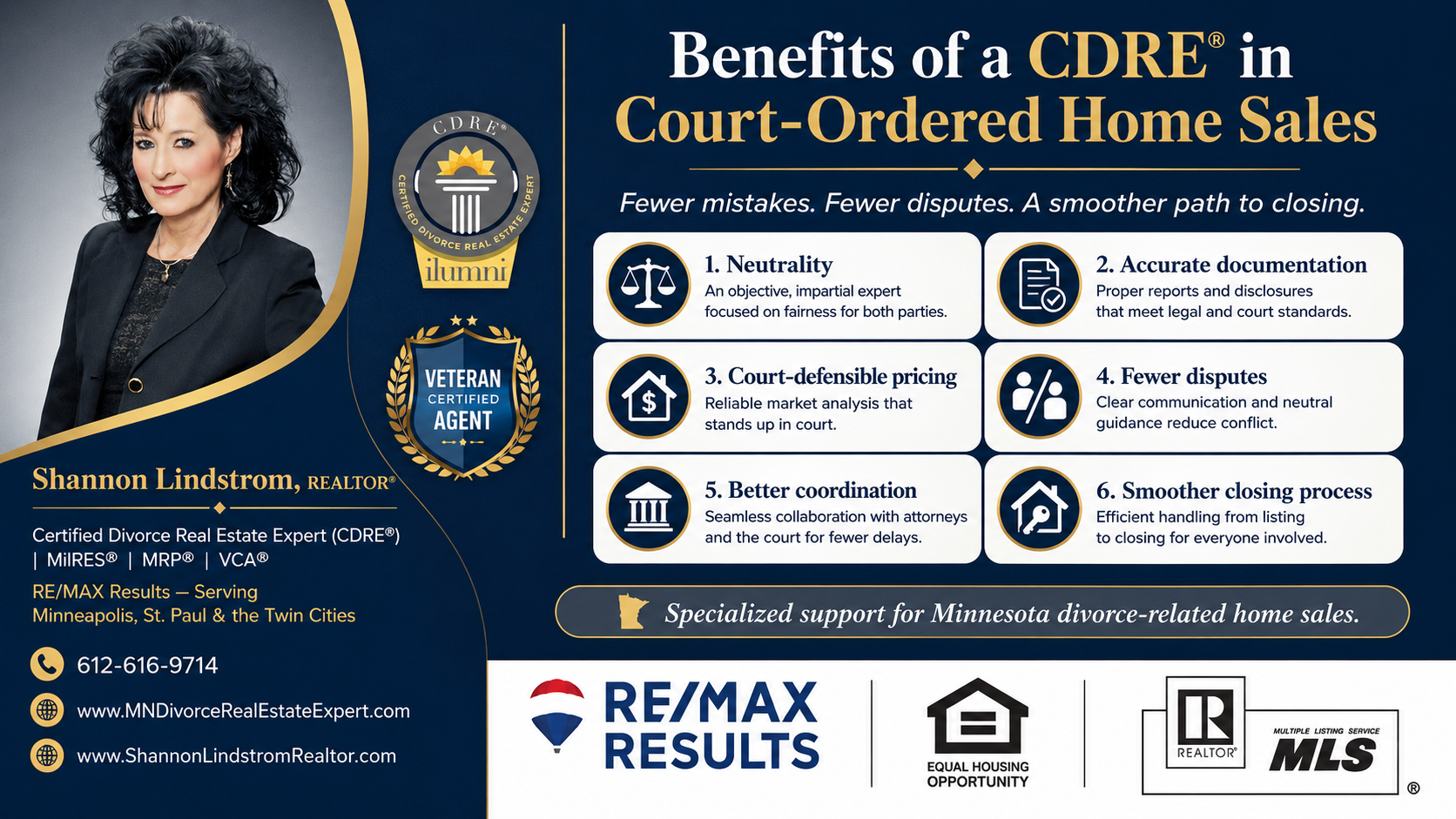
Shannon Lindstrom, REALTOR® Certified Divorce Real Estate Expert (CDRE®) | MilRES® | MRP® | VCA®
RE/MAX Results — Serving Minneapolis, St. Paul & the Twin Cities
Disclaimer: This article is provided for general informational and educational purposes only and reflects the perspective of a licensed Minnesota real estate professional. It is not legal advice, financial advice, tax guidance, or a substitute for consultation with a qualified attorney, financial professional, or the court itself. Every court-ordered sale is governed by the specific language of the order issued in that case, and the steps, timelines, and decision-making authority described here may vary based on the order and the circumstances. Readers are strongly encouraged to consult their own legal counsel and qualified professionals before making decisions about a court-ordered home sale. Shannon Lindstrom and RE/MAX Results assume no liability for actions taken based on the information contained in this article.