
Divorce, Real Estate, and the Marital Home: Guiding Individuals and Families Through Emotional Transition in Minneapolis, St. Paul, and Across Minnesota
There is a moment that almost every client I work with describes the same way. They're standing in the doorway of the house — sometimes with a moving box, sometimes with nothing at all — and they just stop. The rooms look different when they're empty. Smaller. Or sometimes bigger. And the weight of what is happening settles in, heavy and real, in a way that no legal document or financial spreadsheet quite prepared them for.
Leaving the marital home is emotionally complex transitions a person can experience. And in my work as a Certified Divorce Real Estate Expert (CDRE®) serving Minneapolis, St. Paul, and the surrounding Twin Cities communities, I've come to believe that the emotional side of this process deserves just as much attention as the financial one.
This article isn't about square footage or closing costs. It's about the part of the process that nobody puts on the listing sheet — and what it actually feels like to close the door on a home that held so much of your life.
"Grieving the loss of your home doesn m'tean you made the wrong decision. It means you loved your life there, even the parts that were imperfect."
I want to normalize that completely. Grief rarely arrives on a schedule we'd have chosen for it.
What the Research on Home and Identity Tells Us
Psychologists who study the relationship between people and their living spaces — a field called environmental psychology — have long documented how deeply we tie our sense of self to the places we inhabit. Our homes aren't just shelter. They're autobiographies. We pour ourselves into them: the paint color we deliberated over for two weeks, the garden we started from seed, the scuff on the hallway baseboard that we always meant to fix and somehow never did.
When a home is sold during or after divorce, what's happening psychologically is a kind of identity disruption. The external environment that reflected and reinforced who you were — as a partner, as a parent, as a person — is being dismantled. That's disorienting even under the best of circumstances.
Grief After Leaving a Home Is Real — and It Matters
One of the first things I want people to hear is this: grieving the loss of a home does not mean you made the wrong decision about your marriage. It does not mean you are weak. It means you are human.
For most people, grief is not really about the house itself. It is not just the walls, the rooms, or the property. It is about everything that home came to represent. It holds the life you thought would continue there, the traditions you expected to keep, the milestones you imagined celebrating, and even the quiet, everyday moments that only later reveal how meaningful they were.
What we are often grieving is not just a place, but the future we believed would happen there. That kind of loss can feel surprisingly deep, and it deserves to be met with compassion rather than judgment. Healing does not happen by pretending the loss is small or by forcing yourself to move on too quickly. It begins by honoring what that home meant to you, while also trusting that new memories, new peace, and new beginnings are still possible.
Many of my clients throughout the Minneapolis–St. Paul metro are caught off guard by how strongly they mourn a home they may not have even especially liked. They assume they will feel only relief once the home goes on the market. Instead, they often experience both relief and sadness at the same time. That mix of emotions can surface unexpectedly during a showing, while sorting through belongings, or even at the closing table.
Grieving the loss of your home does not mean you made the wrong decision. It means that life there mattered to you, even if it was imperfect.
That is something I want to normalize completely. Grief rarely shows up on a timeline that feels convenient. It comes in waves, often when you least expect it. But feeling it does not mean you are stuck. It means you are processing a meaningful change, and with time, support, and care, it is possible to move forward with both honesty and hope.
Understanding this isn't just an intellectual exercise. It's actually useful. When you know why leaving the home feels so profound, it becomes a little easier to give yourself grace when the process doesn't feel straightforward or "logical." Grief rarely is.
If You Have Children: Their Grief Matters Too
For parents, the emotional complexity of leaving the marital home is doubled — because you are also holding space for your children's feelings about the transition, often while managing your own.
Children, depending on their age, may experience the loss of the family home as a loss of safety, predictability, and identity. The house was their world. Their room, their backyard, their walk to school, the neighbor's dog they've petted every morning. All of that changes.
A few things that can help:
• Let them say goodbye:Give children a chance to walk through the house before it's sold, to take photos, to say what they'll miss. Ritual matters at every age.
• Validate without catastrophizing: "Yes, this is hard, and we're going to be okay" is both true and supportive.
• Involve them in the new beginning:Letting kids choose something for their new space — a bedspread, a plant, the color of an accent wall — gives them agency and forward momentum.
• Watch for behavioral signs: Regressive behavior, withdrawal, or academic slippage can all signal that a child is struggling with the transition and may benefit from professional support.
• Be honest at their level: Age-appropriate honesty, delivered calmly, is almost always better than protective vagueness.
You don't have to have it all figured out to be a good parent through this. You just have to keep showing up — which you're already doing.
Practical Rituals for Closure
One of the things I've observed over years of working with divorcing clients is that the people who move through the transition most healthfully are usually those who find some way to mark the ending — to create a moment of intentional closure rather than simply walking out and trying not to look back.
Closure doesn't mean resolution. It doesn't mean you stop feeling the loss. It means you give the ending the weight it deserves, and then — gently, imperfectly — you turn toward what's next.
Ways some individuals have found closure:
• A final walkthrough, alone:Before the movers arrive, or after the last box is loaded, take 20 minutes to walk through every room by yourself. Stand in the spaces. Remember. Say thank you, if that feels right.
• Write a letter to the house: This sounds unusual, but many people find it tremendously helpful to write down what the home meant to them — what they learned there, what they'll carry with them. You don't show it to anyone. It's just for you.
• Take photographs of the things you'll miss: The light in the kitchen in the afternoon. The view from the back deck. The way the snow piles on the old oak out front.
• Plant something from the garden in a pot: If there's a plant that matters to you — a rose bush, an herb garden, a seedling — transplant a piece of it. Take something living with you.
• Mark the moment with someone who loves you: Have a trusted friend or family member with you on moving day, or nearby. This is not a day to be alone if you can help it.
When "Selling the House" Feels Like Failure
I want to speak directly to something I hear from individuals, sometimes spoken aloud and sometimes not: the feeling that selling the marital home means something failed. That you failed.
This is one of the most painful stories we tell ourselves, and I want to offer a different frame.
The decision to sell a home during divorce is, in most cases, the most financially responsible and legally straightforward path forward. It is a decision made by adults who are doing difficult work — the hard, unglamorous work of disentangling a life and building a new one. There is nothing small about that.
The home was a chapter. A meaningful, important chapter. But it was not the whole story. And chapters end — not because the story has failed, but because the story is still going.
"The home was a chapter. A meaningful, important chapter. But it was not the whole story."
Some of the most complete, thriving people I know are people who have lived through the exact transition you are in right now. They sold the house. They moved into something smaller, or started renting for the first time in years, or moved closer to family. And with time — real time, not Instagram time — they discovered that home is something they carry inside themselves, not something they leave behind at an address.
The Role of a CDRE® in Protecting You — Emotionally and Practically
A Certified Divorce Real Estate Expert is here to protect more than just the transaction. My role is to help protect your peace of mind, your financial interests, and your ability to move forward with clarity during a very difficult season.
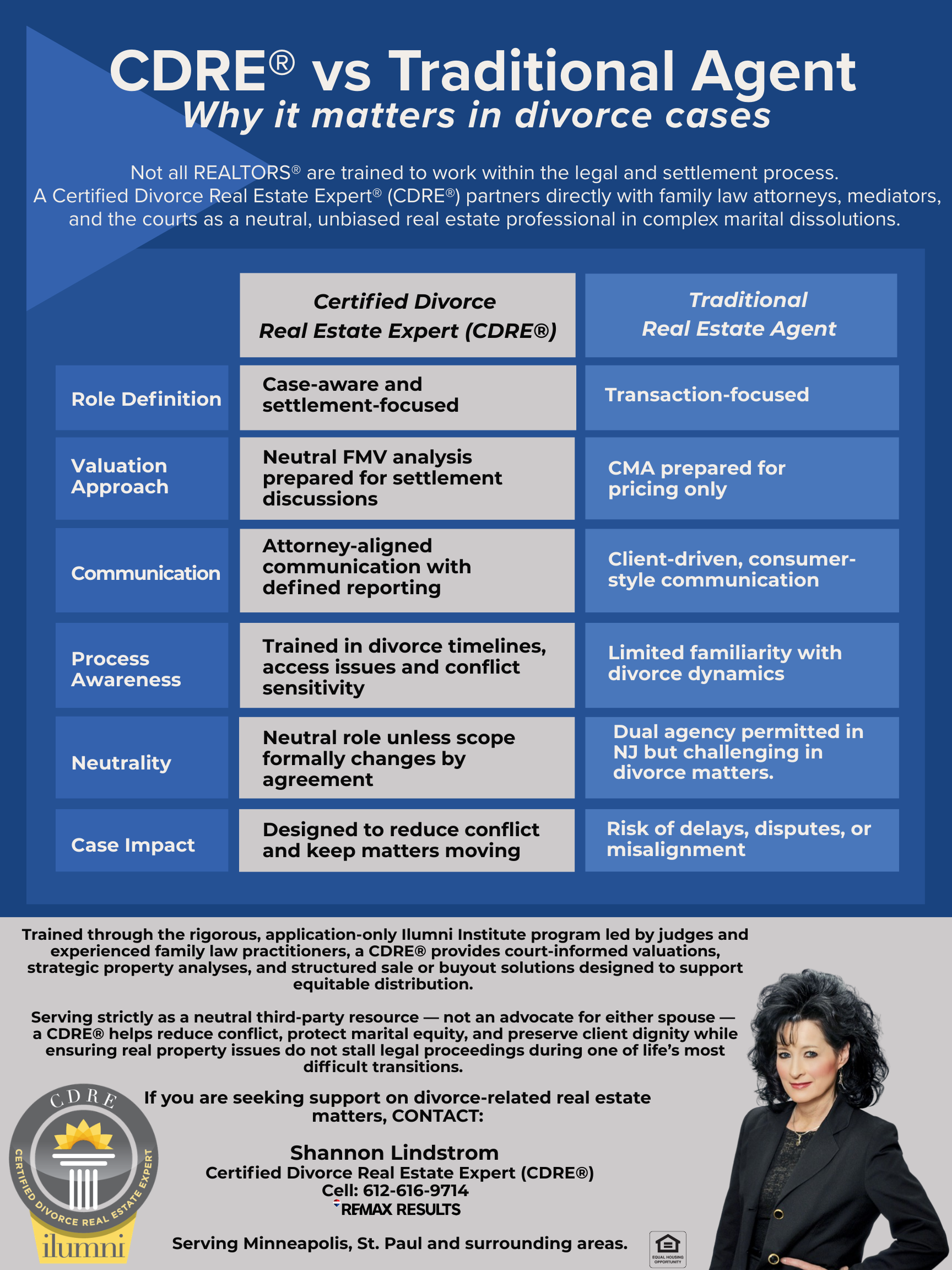
This is where my work as a Certified Divorce Real Estate Expert becomes meaningfully different from that of a traditional real estate agent. Most real estate agents are trained to sell homes. A CDRE® is specifically trained to work at the intersection of real estate, divorce, and family law, with a clear understanding that this process is not just legal or financial, but deeply personal. Divorce brings layers of emotion, uncertainty, and complexity that require a different level of care, strategy, and neutrality.
A CDRE® understands how to navigate the unique challenges that come with selling, keeping, or dividing a home during divorce. That includes not only the practical side of the process, but also the emotional weight that often comes with it. My job is to help create a path that is informed, fair, and steady, so you can make decisions from a place of confidence rather than pressure.
The goal is not just to help you get through the sale of a home. It is to help you move through this chapter with as much protection, dignity, and hope as possible.
That means a few things that matter deeply in situations like yours:
• Neutrality: I work for the transaction, not for one spouse. Both parties can trust that I'm giving honest, unbiased real estate guidance — which reduces conflict and speeds resolution.
• Communication that protects you:I'm trained to communicate with both spouses in ways that don't escalate emotion or conflict, even when the situation is high-tension.
• Coordination with your legal team: I work directly with family law attorneys, mediators, and financial professionals to make sure the real estate process aligns with your legal proceedings.
• Understanding of court timelines:If a court has ordered the sale of the home, there are specific legal parameters I understand and work within — parameters that a general agent may not be familiar with.
• A steady presence when emotions run high: I have worked with clients who cried during showings, who couldn't agree on which boxes to take, who needed to stop mid-process and breathe. This is part of the work. I don't rush it.
Selling a home during a divorce in Minnesota can feel overwhelming, and the practical side is often more complicated than people expect. From agreeing on a fair listing price, to working through marital property requirements and court orders, to making sure the closing stays aligned with your attorney’s timeline, there are a lot of moving pieces. Having a divorce real estate expert by your side helps bring clarity and steadiness to the process. It gives you the space to focus on the emotional side of this transition, knowing the details are being handled with care, professionalism, and your best interests in mind.
Reframing Your Address
There will come a day — and it may be sooner than you think — when you will give someone a new address, and it will feel genuinely like yours.
Not a compromise. Not a consolation prize. Yours.
A space that reflects who you are now, chosen by you, organized the way you want, as quiet or as full of people as you need it to be.
The path from here to there is real, and it takes time. But it is a path. And you are not walking it alone.
If you are just beginning to sort through what comes next for the marital home — whether that means selling, understanding your options, navigating the process with your spouse, or simply getting a clearer picture of the local real estate market and the possible timeline — you do not have to have all the answers right now.
I am here to help you make sense of it, one step at a time. Our conversation is simply a place to start. No expectation that you have everything figured out before reaching out.
Ready to talk about next steps?
Shannon Lindstrom is a Certified Divorce Real Estate Expert (CDRE®) serving Minneapolis, St. Paul, and the surrounding Twin Cities metro. She works with clients — and their attorneys — to navigate the sale of the marital home with professionalism, neutrality, and genuine care.
Shannon Lindstrom, Realtor®, AHWD, CDRE®, GREEN, MILRES, MRP, VCA
RE/MAX Results
7373 Kirkwood Court No, Ste. 300
Maple Grove, MN 55369
Direct: 612-616-9714
Lindstrom_S@msn.com
Shannon@ShannonLindstromRealtor.com
www.ShannonLindstromRealtor.com
www.ShannonLindstrom.info
www.MNDivorceRealEstateExpert.com
https://www.ilumniinstitute.com/cdre/shannon-lindstrom
Disclaimer: This blog article is intended solely for educational and informational purposes and should not be construed as legal advice. For legal guidance specific to your situation, please consult with a licensed Minnesota family law attorney. Shannon Lindstrom and MNDivorceRealEstateExpert.com assume no responsibility for the accuracy or applicability of the information presented here to any individual's circumstances.