
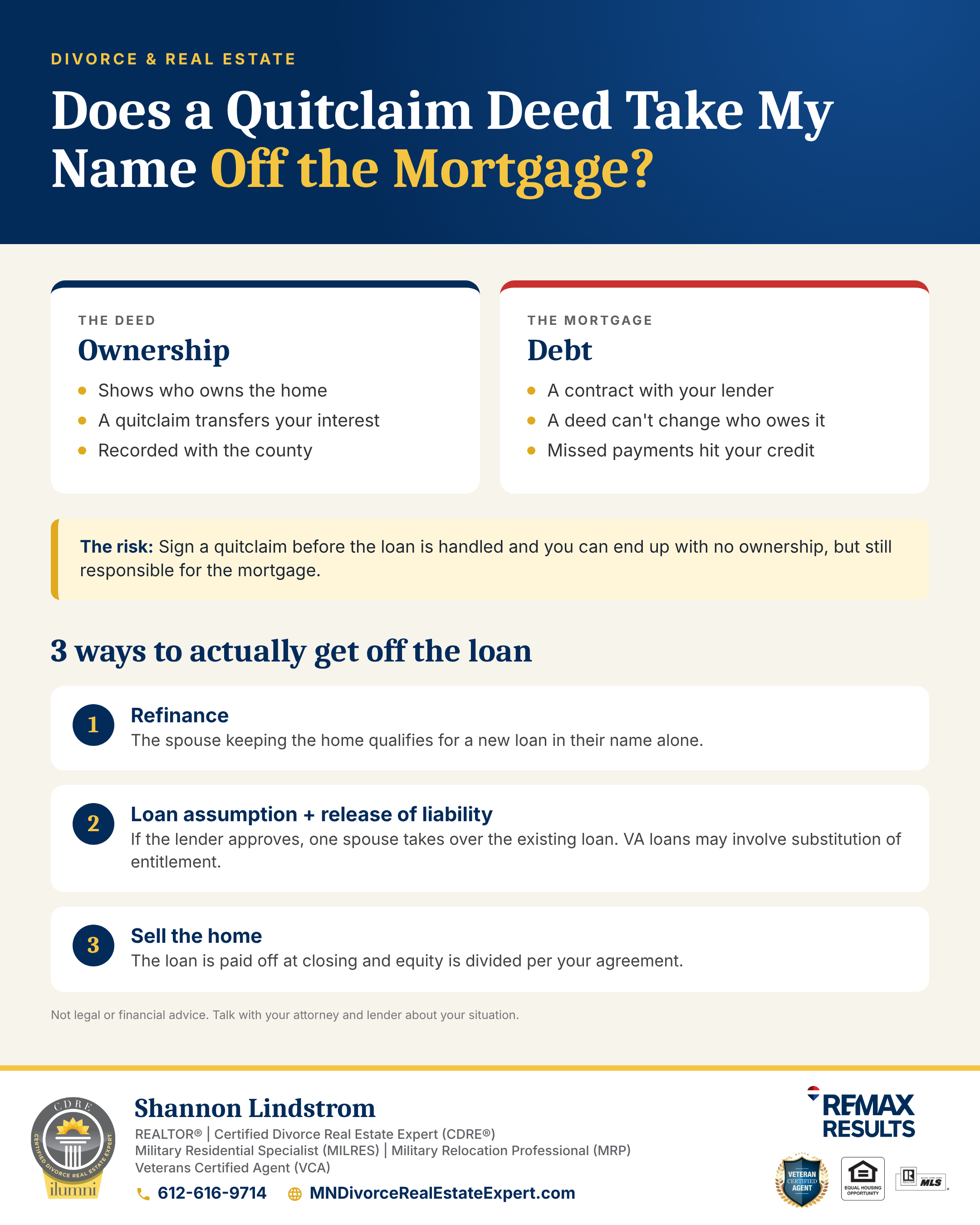
Short answer: no. A quitclaim deed takes your name off the title. It does not take your name off the mortgage. If you signed the loan, you are still on the hook for it until the loan is paid off, refinanced, or the lender formally releases you.
I hear this question often, and I understand why. When you are going through a divorce, signing a quitclaim feels like closing a chapter. You hand over your interest in the house, your spouse keeps it, and you move on. It seems logical that the debt would go with the house.
Unfortunately, that is not how it works. And the people who learn this the hard way often find out years later, when a late payment shows up on their credit report for a home they no longer own. My goal here is to explain the difference clearly so you can protect yourself before you sign anything.
The Deed and the Mortgage Are Two Different Things
This is the heart of the confusion. When you bought your home, you likely signed two separate sets of documents:
The Deed The Mortgage (and Promissory Note)
What it is Proof of ownership A loan and your promise to repay it
Who it involves You and the county records You and your lender
What a quitclaim changes Your ownership interest Nothing
A quitclaim deed simply says, "Whatever ownership interest I have in this property, I give to you." It is recorded with the county, and once it is, you no longer own any part of the home.
But your lender was never a party to that deed. Your loan agreement is a contract between you and the bank. You cannot remove yourself from that contract by signing a document the bank never agreed to. The same is true of your divorce decree. Even if the judge orders your spouse to pay the mortgage, the lender is not bound by that order. It can still look to you for payment.
What Happens If You Sign the Quitclaim but Stay on the Loan
This is the worst of both worlds, and it happens more than people realize. You have given up ownership, but you still carry the risk. Here is what that can look like in real life:
Missed payments hit your credit too. If your former spouse pays late, the lender reports it on both of your credit reports.
Foreclosure can follow you. If the loan goes into default, a foreclosure can appear on your record for years.
Your buying power shrinks. When you apply for a new mortgage, lenders generally count that existing payment as your debt, which can limit how much home you qualify for.
You have no control. You cannot sell the home, refinance it, or make decisions about it, because you no longer own it.
How to Actually Get Your Name Off the Mortgage
There are four realistic paths. Each one depends on the lender, the loan type, and the finances of the spouse keeping the home.
Refinance. The spouse keeping the home applies for a new loan in their name alone. The new loan pays off the old one, and your obligation ends. This is the most common solution, but it requires that spouse to qualify on their own income and credit, and current interest rates may make it more expensive than the original loan.
Loan assumption. Some loans, including many FHA, VA, and USDA loans, can be assumed. The spouse keeping the home takes over the existing loan, often at the original rate. The lender must approve it, and you need a written release of liability, not just the assumption itself.
Lender release (novation). Occasionally a lender will agree to remove one borrower without a refinance. This is uncommon and entirely at the lender's discretion, but it is worth asking.
Sell the home. When neither spouse can qualify alone, selling is often the cleanest option. The loan is paid off at closing, both names come off, and any remaining equity is divided according to your agreement.
One helpful note: federal law (the Garn-St Germain Act) generally prevents a lender from calling the loan due simply because one spouse transfers ownership to the other as part of a divorce. That protects the spouse keeping the home. It does not remove the departing spouse from the debt.
A Special Note for Military and Veteran Families
If your home has a VA loan, there is an extra layer to consider: your VA entitlement. When a veteran leaves a VA loan in place after divorce, part of that entitlement typically stays tied up in the loan, which can affect the ability to use the full benefit on the next home.
If the spouse keeping the home assumes the VA loan, ask the lender and the VA about a release of liability. If the person assuming the loan is also an eligible veteran, a substitution of entitlement may restore the departing veteran's benefit. These details matter, and they are easiest to address before the divorce is finalized.
How to Protect Yourself Before You Sign
The order of events matters. A few practical steps I recommend discussing with your attorney or mediator:
Get a lender pre-approval first. Before agreeing that one spouse keeps the home, find out whether that spouse can actually refinance or assume the loan.
Tie the quitclaim to the refinance. Many attorneys arrange for the quitclaim to be signed at, or held until, the refinance closing. That way, ownership and the debt transfer at the same time.
Put deadlines in the decree. If a refinance is required, the agreement can set a clear deadline and spell out what happens if it is missed, such as a required sale.
Keep an eye on the loan. If you remain on the mortgage for any period, ask for access to statements or set up payment alerts so you are not caught off guard.
Build the right team. Your attorney, mediator, financial professional, lender, and a divorce-trained Realtor® each see a different piece of the picture.
A quitclaim deed is a useful tool, but it only solves half the problem. Ownership and debt are separate, and both need to be addressed for a clean financial break.
As a Certified Divorce Real Estate Expert (CDRE®), I serve as a neutral resource for both spouses and work alongside attorneys, mediators, and financial professionals throughout the Twin Cities. Whether the best path is a refinance, an assumption, or a sale, my role is to help you understand your options clearly so you can make a decision you feel confident about.
If you have questions and/or wish to schedule an appointment to discuss how Shannon Lindstrom can help you, please call, text or email her at your earliest convenience.
Shannon Lindstrom, REALTOR® | Certified Divorce Real Estate Expert (CDRE®), MILRES®, MRP®, VCA®
RE/MAX Results — Serving Minneapolis, St. Paul & the Twin Cities
📞 612-616-9714
🌐 www.shannonlindstromrealtor.com
🌐 www.MNDivorceRealEstateExpert.com
🌐 www.ilumniinstitute.com/cdre/shannon-lindstrom
This article is for general information only and is not legal, tax, or financial advice. Every situation is different. Please consult your attorney, lender, and financial professional about your specific circumstances.