How a Neutral Certified Divorce Real Estate Expert (CDRE®) Protects Both Parties' Equity
When a marital home is part of a divorce settlement, one question sits underneath almost every negotiation: who does the real estate agent actually work for?
If the answer is "one spouse," it introduces risk — the appearance of bias, the potential for disputed decisions, and a transaction that can become another point of conflict rather than a resolution. This is exactly the problem a Certified Divorce Real Estate Expert (CDRE®) is trained to solve.
What "Neutral" Actually Means in Practice
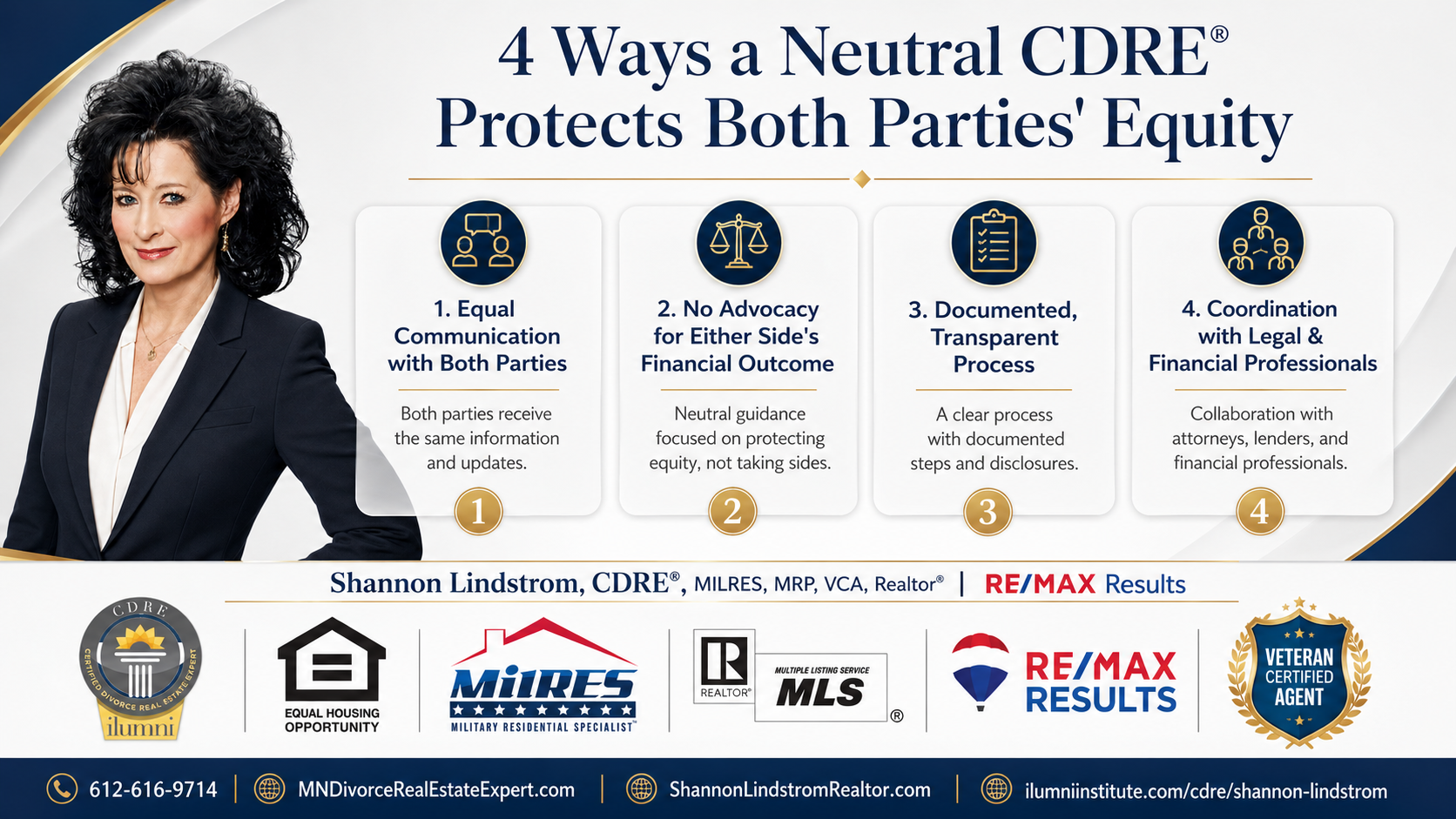
Being a neutral CDRE® isn't a marketing label — it's a defined way of operating a transaction:
Equal communication with both parties. Updates, showing schedules, offers, and decisions are shared consistently with both spouses — not filtered through one.
No advocacy for either side's financial outcome. My role is to help the property sell for the strongest achievable price and terms, full stop, not to negotiate on behalf of one spouse against the other.
Documented, transparent process. From pricing strategy to repair negotiations, decisions are made using market data and professional judgment, not the preference of whichever spouse is more vocal or more available.
Coordination with legal and financial professionals. I work directly with attorneys, mediators, and financial advisors to make sure the real estate timeline and process align with the terms of the settlement — not around them.
Why This Protects Equity — Not Just Feelings
Neutrality isn't just about keeping the peace. It has a direct financial impact:
1. Pricing stays market-driven, not conflict-driven. In contested sales, one spouse may push to price too high (to delay a sale they don't want) or too low (to force a fast exit). A neutral CDRE® anchors pricing to data — protecting the equity both parties are entitled to.
2. Decisions don't get stalled by mistrust. When one party suspects the agent favors the other spouse, everything slows down — showings, offer reviews, repair negotiations. Delays cost money: additional mortgage payments, carrying costs, and market timing risk that erodes net proceeds for both sides.
3. Disputes get resolved with data, not leverage. Repair requests, buyer negotiations, and closing terms are handled based on market norms and professional standards — reducing the chance that one spouse "wins" a negotiation point at the direct financial expense of the other.
4. It reduces the chance the case returns to court. A transaction that both parties trust is far less likely to generate a motion, a dispute, or a call back to your office. A neutral, well-documented process is often the difference between a clean closing and a contested one.
Why This Matters for Attorneys Specifically
In a divorce-related real estate transaction, even the perception of favoritism by a real estate professional can create additional concerns about neutrality, communication, and fairness—regardless of the quality of the legal representation or the merits of either party’s position.
Referring clients to a Certified Divorce Real Estate Expert (CDRE®) -trained real estate professional who understands the importance of professional neutrality can help support a more transparent and well-documented real estate process. This includes consistent communication practices, careful documentation, appropriate professional boundaries, and coordination with the parties’ attorneys, financial professionals, and other relevant professionals when appropriate.
For attorneys, this can provide several practical benefits:
May reduce avoidable real estate-related disputes by establishing clear communication, documentation, and transaction procedures from the outset.
Provides clients with a real estate professional who understands the heightened sensitivities of divorce-related transactions, including confidentiality, competing interests, court timelines, and attorney involvement.
Creates a more clearly documented transaction record if questions later arise regarding communication, valuation information, marketing decisions, offers, or transaction conduct.
Supports appropriate professional coordination while respecting the distinct roles of the attorneys, financial professionals, and real estate professional.
Allows counsel to remain focused on legal advocacy and strategy while the real estate component is handled by a professional with specialized training in divorce real estate matters.
A Specialized Layer for Military and Veteran Families
For military and veteran clients, neutrality has to extend further — factoring in VA loan entitlement splits, BAH and housing allowance timing, PCS-driven deadlines, and SCRA protections. As one of the few Certified Divorce Real Estate Expert (CDRE®), MILRES, MRP, and VCA-certified Realtors® in Minnesota, I bring that additional layer of expertise to military divorce cases specifically, so nothing about a service member's or veteran's unique situation gets missed.
Equity protection in a divorce isn't just about the number in the settlement agreement — it's about how that number gets realized through the actual sale. A genuinely neutral, specially trained real estate professional is one of the most effective ways to protect that outcome for both parties, and to protect your own practice from avoidable real estate disputes.
I’m always happy to serve as a resource for attorneys, mediators, and divorce professionals throughout the Twin Cities and greater Minnesota, whether that involves a brief consultation on a specific case or ongoing collaboration as needs arise.
Shannon Lindstrom, CDRE®, MILRES, MRP, VCA Realtor®
RE/MAX Results
📞 612-616-9714
🌐 www.MNDivorceRealEstateExpert.com
🌐 www.shannonlindstromrealtor.com
🌐 Shannon Lindstrom CV